
Food Establishment Licensing and Permitting
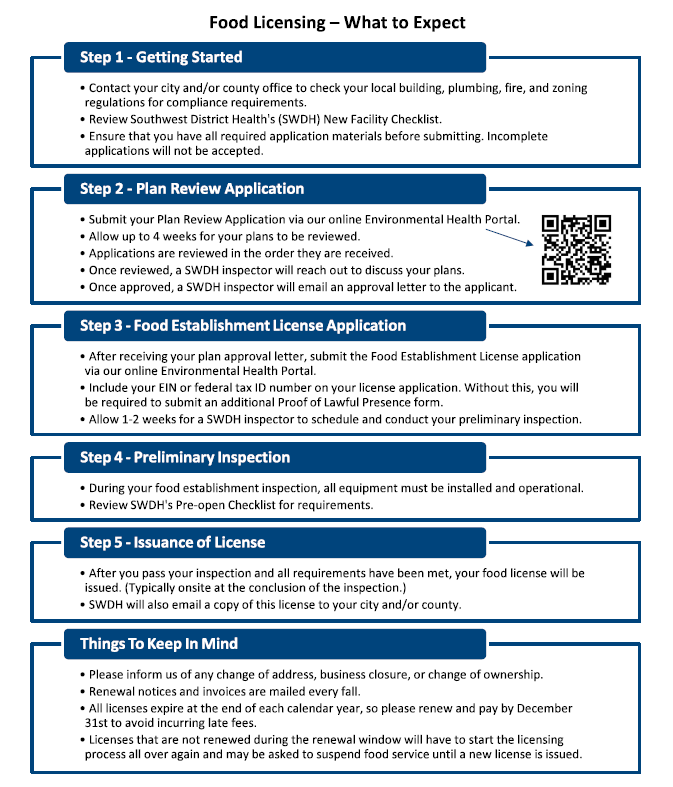
In Idaho, an establishment that offers Time/Temperature Control for Safety Foods (TCS) must be licensed by the local regulatory authority. This includes, but is not limited to, restaurants, grocery stores, convenience stores, institutions, mobile food trucks/carts, temporary event vending, processors, caterers. If you are unsure if your operation is required to be licensed or believe your product is a low risk/cottage food, please see the section below or contact Southwest District Health.
FOOD INSPECTION RESULTS
Search the Restaurant Inspection Database HERE. Click on Food Inspection Results in the menu.
Please follow the link to our online application and payment portal for further information on food establishment licensing.
Environmental Health Portal
Use the Environmental Health Portal to submit applications, search for records, make payments, and more.
Cottage Foods
Cottage foods are foods made in a person’s home or other designated location and sold directly to a consumer. They include foods that are defined in the IDAHO FOOD CODE as non-Time/Temperature Control for Safety (nonTCS) foods. Examples of cottage foods include: baked goods that do not require refrigeration, fruit jams and jellies, honey, fruit pies, breads, cakes that do not require refrigeration, pastries and cookies that do not require refrigeration, candies and confections that do not require refrigeration, dried fruits, dry herbs, dry seasonings and mixtures, cereals, trail mixes and granola, nuts, vinegar and flavored vinegars, popcorn and popcorn balls, or tinctures that do not make medicinal claims.
Certified Food Protection Manager Training
Southwest District Health instructs in-person CFPM courses on a regular basis. Please use the link to our online payment and application portal above for more information and to sign up for an in-person class. Southwest District Health does not offer an online CFPM course at this time.
Low Risk Foods
Idaho Direct to Consumer Commerce Act
Fraternal, Benevolent, or Non-Profit Charitable Organizations
Resources:
If you intend to sell or serve foods that require time/temperature control for safety (TCS), and/or you sell the product to a third party, then your food establishment must be regulated and meet all the requirements described in the IDAHO FOOD CODE. Refer to the Idaho Food Code for a complete definition of TCS foods.